
The Holdback Clock Starts Before the Paperwork Is Ready

On most building projects, the last few weeks feel like an ending. The punch list shrinks, the trades demobilize, the keys change hands. Legally, they are a beginning. The day a project is treated as complete starts a short, strict clock that decides who can still make a claim against the property and when the owner can safely release the money it has been holding back. That clock does not wait for the closeout binder.
Recent context
Every province runs its own version of this clock, and the windows are short. In British Columbia, owners must retain a 10% holdback from each payment and keep it until the lien period has passed, and a lien generally has to be filed within 45 days of triggers such as substantial completion, abandonment, termination or a certificate of completion, as this practical guide to the Builders Lien Act summarizes. Ontario lengthened its preservation period from 45 to 60 days when the Construction Act replaced the old Construction Lien Act, as this overview of the reform notes. Alberta moved its general registration period from 45 to 60 days under the Prompt Payment and Construction Lien Act, with 90 days for some concrete supply and for oil and gas sites, according to Miller Thomson's summary.
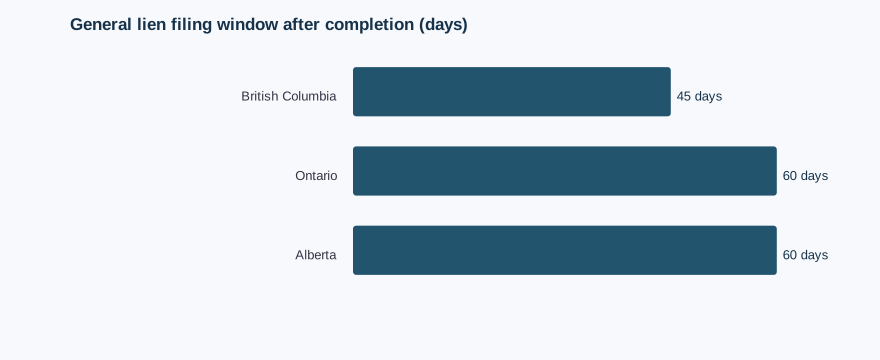
Forty-five or sixty days sounds like plenty of time. On a real project it is not, because the clock usually starts on a date that someone has to find, prove and agree on.
Where the date hides
The trigger for the lien period is a fact about the project, and facts about projects live in documents. In practice the evidence is scattered across several of them.
- The certificate. If a certificate of completion or substantial performance was issued, the question is when, by whom, and whether it was posted or published as the legislation requires. A certificate sitting in a consultant's outbox has not started anything.
- The deficiency list. Whether work is substantially complete often turns on what was still outstanding and what it was worth. A list that was updated by email, on site and in a spreadsheet tells three stories.
- The last day of work. For trades without a certificate, the clock can run from the last work done. Daily logs, delivery tickets and gate records become evidence, and they are rarely kept with that in mind.
- The payment ledger. The holdback amount has to be traceable for each contract, separately from the progress payments, or the owner cannot show what it retained and when it released it.
What it costs to get the date wrong
Release the holdback too early and the owner may end up paying twice: once to the contractor, and again to a subcontractor or supplier who files a valid claim within the window. Hold it too long and the owner damages relationships, invites interest claims under prompt payment rules and ties up money that the next project needs. Either way, the decision is only as good as the record behind it, and the people who will be asked to defend it are often not the people who made it.
A closeout routine that protects the owner
None of this requires a lawyer on every project. It requires treating closeout as a records exercise that starts before the last trade leaves.
- Name the trigger in advance. For each contract, record which event is expected to start the lien period and who is responsible for issuing or confirming it.
- Date-stamp the evidence. File the certificate, the posting or publication proof, the final deficiency list and the last-work records together, under the contract they belong to.
- Calculate the release date in writing. Put the expiry date of the lien period in the file and in the payment schedule, with the statute it was calculated under.
- Check the land title office before releasing. Search for registered claims at the end of the period, and keep the search result with the release approval.
- Release under the right authority. Holdback release is a payment like any other and should be approved by whoever holds the spending authority for that amount.
The binder is part of the building
Owners tend to think of closeout documents as something to hand over once the real work is done. The holdback rules say otherwise. The date a project was complete, the proof that everyone was told, and the record of what was held and paid are what let an owner release money with confidence and answer questions years later. They deserve the same care as the as-built drawings, and they should be in one place before the clock runs out, not assembled after it.
This article is general information, not legal advice. Lien rules differ by province and by contract, so confirm the deadlines that apply to your project with qualified counsel.