Why Bill C-5 and the new Major Projects Office Puts Municipalities on the Clock

Bill C-5 and the new Major Projects Office made one thing clear in 2025: getting capital projects approved is no longer the bottleneck. Delivering them — and being able to show your work — is.
What's really at risk isn't tidiness. It's whether a funder, an auditor, or a partner can look at your project and trust that it was run the way you say it was.
Funded is not the same as finished
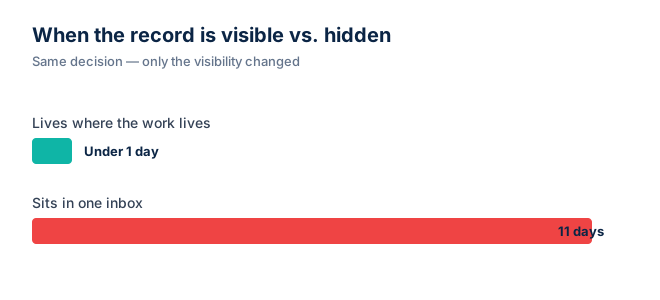
The real problem for municipalities isn't missing information — it's unfindable information. The approval, the version, the justification all exist; they just don't live where the work can see them.
It compounds over time. Every handoff between municipalities and their partners is a chance for a version to fork, an approval to go unrecorded, or a commitment to survive only in someone's memory.
There is a reason this keeps happening even to careful municipalities. The tools that hold the work — email, shared drives, spreadsheets, a project app or two — were each built to do one job well, not to keep a single, time-stamped record of what was decided and why. So the record becomes a manual chore bolted onto the real work, and it is the first thing to slip when roads, water, and facilities renewal gets busy. In a year shaped by Bill C-5 and the new Major Projects Office, that one dropped chore is exactly what returns, months later, as a finding, a dispute, or a number nobody can explain.
Here is where the proof tends to hide:
The decision record — who approved what, when, and on what basis
Invoices matched to the contract that authorized them
The procurement justification, documented at the time
Version history proving which drawing was current on a given day
Funded is not the same as finished
If you keep nothing else in a single system, keep these:
Approvals and sign-offs. Every gate with a name and date attached, visible to everyone the decision touches.
Invoices matched to the contract. Each dollar paid, tied to the commitment that authorized it.
The contract and its change orders. The original plus every amendment, in order, with nothing living only in an email thread.
Meeting minutes and direction. Especially anything that changed scope, schedule, or budget.
The decision record. Who approved what, when, and on what basis — captured as it happened, not reconstructed under pressure.
None of this is a discipline problem. Diligent people lose records every day. It's a structure problem — and structure is fixable.
That is exactly what XNM-VISION is built to do. It keeps capital projects and the records that prove them in one auditable system — approvals, versions, contracts, and change orders, each with a name and a date attached.
What changes the result for municipalities is not another database. It's that XNM-VISION captures the record as a by-product of the work, ingesting from the inboxes and folders you already use — so being ready costs no extra effort.
The lesson repeats across every sector. You don't survive scrutiny by preparing for it. You survive by never being in a position that needs preparing.
Where the friction usually starts
In most capital teams, the trouble does not begin with a dramatic failure. It starts with small mismatches: a budget number that someone updated in a side spreadsheet, a scope clarification agreed verbally in a hallway, a signed amendment that lives only in one person's email. None of these feel urgent in isolation. Together, they quietly become the gap that an auditor, a funder, or a board member will eventually find.
The fix is not more meetings or longer reports. It is a single place where the current version of every decision lives, with the name and date attached, the moment it happens. When that becomes the default working surface — not a system people copy into later — the friction drops because nothing has to be reconstructed.
Consider a generic but realistic scenario: a regional infrastructure team awards a contract, then issues two change orders during construction. Months later, a funder asks for the audited cost-to-date and the basis for each change. If the record was kept at the moment of the decision, the answer is a search. If it was not, it is three weeks of interviews and forensic email reading.
A single working version of every key document, with prior versions kept but clearly archived
An attached name and date on every approval, sign-off, and scope change
A short written reason next to every procurement award, captured at the time
A simple way for the people doing the work to log what changed, without leaving their tools
What good looks like in practice
In practice, an audit-ready workspace does not require heroic discipline from every team member. It requires that the path of least resistance is also the right path. When the easiest place to drop a signed PDF is also the official record, when the easiest way to log a decision is also the auditable log, behavior follows the design.
Practical steps that move teams in that direction, in roughly the order they tend to land:
Pick one home for the record. Decide where the official version of each artifact lives, and retire the side copies.
Attach names and dates by default. Every approval, every sign-off, every change carries a person and a moment, captured as it happens.
Keep the reason next to the decision. A two-sentence note at the time beats a paragraph of reconstruction later.
Make the audit view a click away. If pulling the full trail takes a single search, the team will keep using the system that produces it.
The deeper benefit is cultural. When the record is reliable, conversations change. Disagreements move faster because the facts are not in dispute. New team members get up to speed in days instead of weeks, because the history of the project is legible without a guide. And leadership can ask harder questions, because the answers are available.
Why this matters now: funders, regulators, and boards are tightening their expectations around traceability and timeliness. The teams that build the record as the work happens will spend their energy on the work. The teams that do not will spend their energy on reconstruction — and on explaining the gaps.
How XNM-VISION helps is straightforward. It keeps the current version, the approval, the reason, and the trail in one auditable place, accessible to the right people at the right tier, with the audit view ready whenever it is asked for. The system does the remembering so the team can keep building.
Want to see what one source of truth looks like for your projects? Talk to us — it's a short conversation.