The Audit That Found the Gap First

The auditor circled one line in the spreadsheet and asked a single question: who approved this change? Around the table, five people who had worked on the project for two years looked at each other. The decision had been made. The money had been spent. The work was finished, inspected and signed off. But the approval itself — the actual moment someone with the authority to say yes had said it — was nowhere to be found. It had evaporated into the gap between a hallway conversation and an invoice.
Here is the part that stings. The auditor found the gap before the team did, and the team had been living inside the project for two years. It was not that the auditor was smarter or more diligent. It was that the auditor read the file the way it was actually written, not the way everyone remembered it. The records told one story. The team's memory told another. When those two disagree, the auditor believes the records — and, given enough time, so does everyone else.
The file is a witness that doesn't forget
A project team carries an enormous amount of context in its head. People remember the meeting where the decision got made, who pushed back, what the workaround was, why the deadline moved. That shared memory feels like documentation. It isn't. It is a story, and stories soften, drift and disappear when people change roles, leave, or simply forget the order of events. An auditor does not have access to that story and does not want it. They want the artifact: the dated, attributable, unaltered record of who decided what, and when.
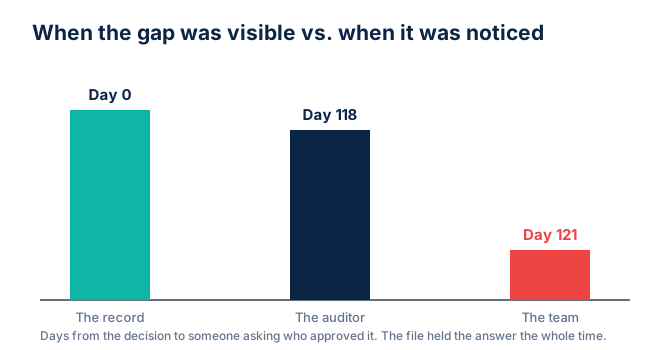
That difference is the whole game. The team experiences the project as a continuous lived narrative. The auditor experiences it as a stack of evidence. Where the narrative is rich and the evidence is thin, the auditor sees a gap that the team literally cannot see, because the team's memory is quietly filling it in. The file showed the missing approval on day zero. The team did not notice until the auditor asked on day one hundred and twenty-one.
Why the gap is invisible from the inside
Record gaps are not usually the result of negligence. They are the result of work moving faster than the system that is supposed to capture it. A decision gets made in a corridor, confirmed by a nod, executed the same afternoon. Everyone present knows it happened, so nobody feels the need to write it down. The gap only becomes visible later, from the outside, when someone who was not in the corridor needs to confirm that the corridor conversation actually took place.
Decisions made verbally and executed before anyone documents them.
Approvals given in email threads that are never linked to the work they approve.
Sign-offs that exist as a signature on paper in a drawer, findable by exactly one person.
Changes recorded in a system the auditor was never given access to.
Each of these feels complete in the moment. Each one is a future gap waiting for someone to ask a question the file can't answer.
What to do before the next audit asks for you
The fix is not more discipline applied through willpower. Willpower fails exactly when a project is busy, which is exactly when decisions matter most. The fix is to make the record a by-product of doing the work, so that approving a change, logging a decision and attaching the evidence are the same action rather than a second chore to be done later and forgotten. When the act of deciding is the act of recording, the gap never opens in the first place.
Run the test yourself this week. Pick one finished decision from a live project and try to reconstruct, from the file alone, who approved it and when. If you can, your file is doing its job. If you find yourself reaching for memory, you have just found the gap before an auditor did — which is the only good time to find it.
We pull apart a different one of these quiet failures every week in our records and accountability series. The pattern is always the same: the answer was in the file, and nobody had read the file the way an outsider would.