
Anatomy of an Overrun: When Capital projects Outrun the Paperwork
Fresh reporting on the national infrastructure deficit made one thing clear in 2025: getting capital projects approved is no longer the bottleneck. Delivering them — and being able to show your work — is.
And the bill always comes due at the worst moment: mid-build, mid-audit, or mid-dispute, when the missing piece is suddenly the only piece that matters.
What fresh reporting on the national infrastructure deficit actually changes
School districts rarely fail for lack of effort. They fail because the proof is scattered — a sign-off here, an invoice there, a change order in a thread no one can find under pressure.
And it bites hardest exactly when it matters most. The day a funder calls, the week an audit lands, the moment a dispute starts — that is when school districts learn which records they can actually produce and which they only thought they had.
It helps to name the real adversary, because it is not incompetence. For school districts, the adversary is entropy — the natural tendency of a busy project to scatter its own evidence across people, tools, and time until no single place holds the whole truth. Every reorganization, every staff change, every 'we'll clean it up later' feeds it. Fresh reporting on the national infrastructure deficit did not create this problem, but it raised the cost of it, because more scrutiny means more moments when scattered evidence has to be pulled back together at speed. Structure is the only thing that reliably beats entropy.
In practice, the gaps cluster in a few familiar places:
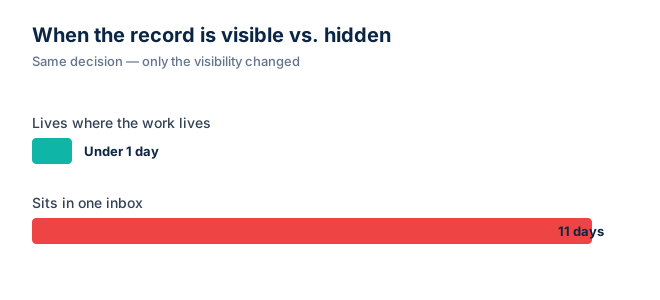
An approval sitting in one person's inbox, with no backup and no clock anyone else can see
A contract on a personal drive that the field crew never opens
A change order buried in an email thread
A verbal 'go ahead' that left no trace
The records that settle questions
The short list of what should never be left scattered:
Approvals and sign-offs. Every gate with a name and date attached, visible to everyone the decision touches.
Procurement justification. Why this vendor, this price, this process — documented at the time, not rationalized after.
The contract and its change orders. The original plus every amendment, in order, with nothing living only in an email thread.
Closeout and retention. What was delivered, who signed for it, and proof you kept what you must keep.
The decision record. Who approved what, when, and on what basis — captured as it happened, not reconstructed under pressure.
The fix isn't 'try harder.' It's to stop keeping the record separate from the work, so the proof accumulates on its own.
XNM-VISION closes that gap for school districts. Every decision, document, and dollar lives in one place, captured as the work happens, so 'audit-ready' is your resting state rather than a sprint.
Teams stand it up fast: XNM-VISION deploys in days, not the months a traditional system takes, and it carries unlimited users, so every partner, reviewer, and field lead works from the same picture.
Fresh reporting on the national infrastructure deficit raised the ceiling on what's possible. Whether school districts reach it comes down to something unglamorous: whether the proof was there all along.
What this looks like in practice
Consider a mid-sized capital build that runs across two fiscal years. The team starts with a feasibility study, then a design phase, then procurement, then construction, then a long warranty and closeout tail. Each phase produces its own paperwork — budgets, drawings, change orders, inspection reports, invoices — and each phase tends to live in a slightly different place. A finance lead keeps the budget in a spreadsheet. A project manager keeps drawings in a shared drive. A consultant keeps the latest revisions on their own server. By the time the project is two years in, nobody can say with confidence which file is current.
The fix is not heroic. It is structural. One auditable system means one place where the current drawing lives, one place where the signed contract lives, one place where the change order log lives, and one place where the invoice trail lives. Everything else is a shortcut to that place. When a question comes in, the answer is always one click away, and the click always lands on the same record.
Why this matters for the next funding cycle
Funders are increasingly asking for evidence, not assurances. They want to see the audit trail before they release the next tranche. They want to see that the budget on the spreadsheet matches the budget in the contract, and that the contract matches the change order log, and that the change order log matches the invoices. When those four documents agree, the conversation is short. When they disagree, the conversation can stall a project for months.
Teams that treat records as an afterthought tend to discover the cost late — usually during an audit or a leadership transition. Teams that treat records as a deliverable tend to move faster the longer they work together, because the system gets richer with every project.
Every approval has a signer, a date, and a version reference.
Every change order links back to the original contract and the amended budget.
Every invoice links back to a purchase order and a delivery confirmation.
Every drawing has a clear status — current, superseded, or for information only.
Every closeout package is assembled as the work happens, not at the end.
A practical first step
The fastest way to move from scattered records to one source of truth is to pick a single live project and treat it as the pilot. Do not try to migrate the archive on day one. Start fresh with the next phase, set up the structure, and let the team feel the difference. Once the pilot is humming, the rest of the portfolio follows almost on its own — people see the calm and want it for their own files.
Pick the pilot project. Choose one that is active, visible, and a few weeks away from a milestone. The pressure of a real deadline reveals the gaps quickly.
Map the documents. List every document the project will produce in the next ninety days, and decide where each one will live. Keep the list short and concrete.
Set the access rules. Decide who can view, who can edit, and who can approve. Write the rules down so they survive a staffing change.
Run the first cycle. Hold one meeting where every document is opened from the new system. The friction points show up immediately and they are usually small.
Lock in the closeout package. Define what the closeout package will contain on day one, not on the last day. Build it as you go.
The teams that do this well are not the ones with the biggest budgets. They are the ones who decide, on a normal Tuesday, that scattered records are no longer acceptable. The decision is small. The compounding effect is large.
Want to see what one source of truth looks like for your projects? Talk to us — it's a short conversation.