
Anatomy of an Overrun: When Capital projects Outrun the Paperwork

Ask anyone running multi-year capital plans across many sites what kept them up in 2023, and the widening municipal infrastructure deficit is only half the answer. The other half is quieter: the fear of not being able to find the one record that settles a question.
This matters because the cost of a lost record is rarely the record. It's the six weeks, the redone work, and the credibility you spend reconstructing something you already had.
Funded is not the same as finished
provincial agencies rarely fail for lack of effort. They fail because the proof is scattered — a sign-off here, an invoice there, a change order in a thread no one can find under pressure.
The cost isn't only the missing document. It's the meeting to look for it, the second meeting to recreate it, and the slow erosion of trust every time someone has to say 'let me get back to you on that.'
It helps to name the real adversary, because it is not incompetence. For provincial agencies, the adversary is entropy — the natural tendency of a busy project to scatter its own evidence across people, tools, and time until no single place holds the whole truth. Every reorganization, every staff change, every 'we'll clean it up later' feeds it. the widening municipal infrastructure deficit did not create this problem, but it raised the cost of it, because more scrutiny means more moments when scattered evidence has to be pulled back together at speed. Structure is the only thing that reliably beats entropy.
These are the records that go missing first:
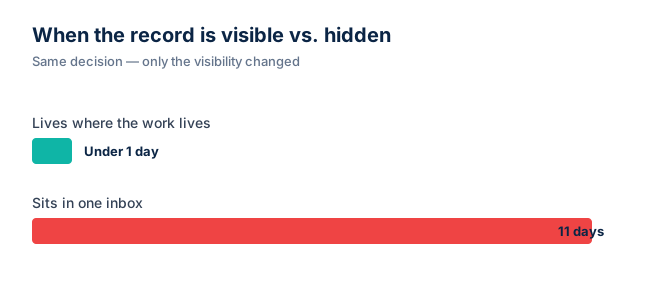
An approval sitting in one person's inbox, with no backup and no clock anyone else can see
A contract on a personal drive that the field crew never opens
A change order buried in an email thread
A verbal 'go ahead' that left no trace
What this looks like on a real project
Picture a mid-sized capital program a year into delivery. Three contractors are on site, two engineering firms are still issuing revisions, and a funder has just asked for a status update before the next disbursement. The work itself is going well. The proof of how it has been going is scattered across three inboxes, two shared drives, and a paper file in the project trailer.
Nothing about that scene is unusual. It is, in fact, the default state of most capital projects that have grown faster than their record-keeping. The team is not careless. They are simply doing what works in the moment — sending an email, saving a PDF, marking up a drawing — without a clean way to make the moment count later.
The cost shows up at the worst possible time: during an audit, a dispute, or a leadership change. Someone asks a precise question, and the answer requires reconstructing a conversation that happened six months ago between two people, only one of whom is still on the team.
A funder request that used to take a week of stitching together now takes an afternoon
A new team member can see what was decided and why, without asking three people
A dispute moves from memory and tone to the record and the timeline
A leadership change does not reset the project's institutional knowledge to zero
What the widening municipal infrastructure deficit actually changes
Put plainly, an audit-ready project keeps these together from day one:
The contract and its change orders. The original plus every amendment, in order, with nothing living only in an email thread.
Meeting minutes and direction. Especially anything that changed scope, schedule, or budget.
Invoices matched to the contract. Each dollar paid, tied to the commitment that authorized it.
Closeout and retention. What was delivered, who signed for it, and proof you kept what you must keep.
Version history. Proof of which drawing, spec, or policy was current on any given day.
None of this is a discipline problem. Diligent people lose records every day. It's a structure problem — and structure is fixable.
With the XNM-VISION records engine, provincial agencies stop hunting. The approval, the current version, and the justification sit together with a full trail — visible to everyone the decision touches, on a clock anyone can see.
Crucially, the XNM-VISION records engine doesn't ask provincial agencies to change how they work. It sits on top of the sources you already have, turning scattered effort into one auditable trail without a migration project.
the widening municipal infrastructure deficit raised the ceiling on what's possible. Whether provincial agencies reach it comes down to something unglamorous: whether the proof was there all along.
How XNM-VISION changes the working day
The shift XNM-VISION makes is small but compounding. Instead of a folder where documents land and an inbox where decisions live, the record and the work share a single object. Approving a change order, attaching a revised drawing, and noting the reason all happen in the same place — and they stay together.
That removes a class of work that nobody enjoyed anyway: the weekly reconciliation between what is actually happening and what the file shows. When the file is the work, reconciliation is not a task. It is a property of the system.
What teams notice first is that meetings get shorter. The opening ten minutes that used to be spent agreeing on what version of reality everyone is looking at simply disappear. The dashboard is the version of reality. Disagreements move to the decision itself, where they belong.
Practical steps to take this quarter
None of this requires a rebuild. The teams that get the most out of a single source of truth tend to do the same handful of things in their first ninety days:
Pick one program to start with. Do not try to migrate everything at once. Choose the project where the cost of disorder is highest and the team is most willing to change one habit.
Move the live record into the system first. Approvals, decisions, current versions, and the schedule. The archive can follow. Today's work is what changes the outcome.
Name an owner for every record class. Contracts, change orders, invoices, drawings, minutes. One name per class, with a clear backup, removes ninety percent of the orphan documents.
Set a weekly five-minute review. Not a meeting — a glance at what is missing, what is overdue, and what is sitting in one person's inbox. The discipline is small. The compounding is large.
The reason this matters is not abstract. Capital projects live and die on the ability to defend a sequence of decisions against people who were not in the room when the decisions were made. The teams that can do that — calmly, on demand — keep their funding, their reputation, and their schedule.
The teams that cannot do that spend their energy re-litigating the past instead of building the next thing. Over a multi-year program, that energy adds up to entire quarters of lost momentum.
XNM has helped public-sector and capital teams make audit-ready their normal state since 2013. See how XNM-VISION works.