Accountability Is a Document, Not a Promise

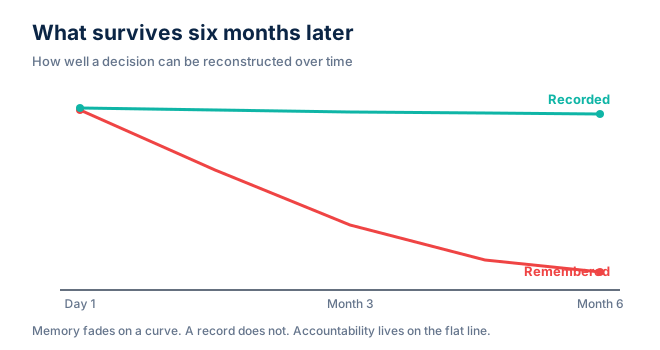
Ask anyone on a struggling project whether they take accountability seriously and they will say yes, and they will mean it. Accountability is not, in most failures, a question of intent. Almost everyone intends to be accountable. The problem is that accountability built on intention is built on memory, and memory has a half-life. Six months after a decision, the people who made it remember it differently, remember it vaguely, or have moved on and don't remember it at all. The promise was sincere. It simply did not survive.
This is the uncomfortable distinction at the center of every governance failure: a promise is a state of mind, and a document is a fact. A promise lives in people and decays as people forget, leave and reinterpret. A document sits outside of all that. It says the same thing in month six that it said on day one, regardless of who remembers what. When we say a project is accountable, we almost always mean the document version, even when we think we mean the promise version.
Why intention can't be audited
You cannot audit a state of mind. You cannot pull someone's good intentions into a meeting and examine whether they hold up. The only thing that can be examined is what was written down — and so, in practice, accountability is not the feeling of responsibility but the existence of a record that ties a named person to a decision at a moment in time. "If it isn't recorded, it didn't happen" sounds harsh until you have watched a roomful of sincere people fail to reconstruct who agreed to what. After that, it just sounds like a description of reality.
None of this is a claim that people are dishonest. It is a claim that people are people. Memory is reconstructive, not a recording; every time we recall an event we subtly rebuild it, and the rebuild drifts toward what we expected or wanted to be true. Two honest colleagues can leave the same meeting with genuinely different memories of what was decided, and both can be completely sincere. The record is the tie-breaker that does not have a stake in the outcome.
Turning promises into documents
The practical move is to stop treating documentation as the paperwork that comes after the real work, and start treating it as the place where accountability actually lives. That is a shift in attitude more than in tooling. It means a decision is not considered made until it is recorded. It means an approval is not considered given until it leaves a trace. It means the question "who owns this?" is answered by pointing at a file, not by recalling a conversation.
A decision isn't final until it's written where others can find it.
An owner isn't assigned until the assignment is recorded, not just understood.
A commitment with a date beats a commitment with a feeling, every time.
If reconstructing it requires a phone call, it wasn't really documented.
The test is simple and a little uncomfortable
Pick a commitment your team is relying on right now — a decision, an approval, an ownership. Ask whether it exists as a document or as a promise. If it is a promise, you are trusting memory to do a job that memory has never reliably done. Turning it into a document takes minutes today and saves the reconstruction that, six months from now, may not be possible at all. Accountability is not how strongly people feel about responsibility. It is whether the record can name who was responsible after everyone has forgotten.
We come back to this idea from a different angle every week in our accountability series. The promise is the easy part. The document is the part that is still there when it counts.