
A Field Guide to Audit-Ready Capital projects for Provincial agencies

Bill C-5 and the new Major Projects Office made one thing clear in 2025: getting capital projects approved is no longer the bottleneck. Delivering them — and being able to show your work — is.
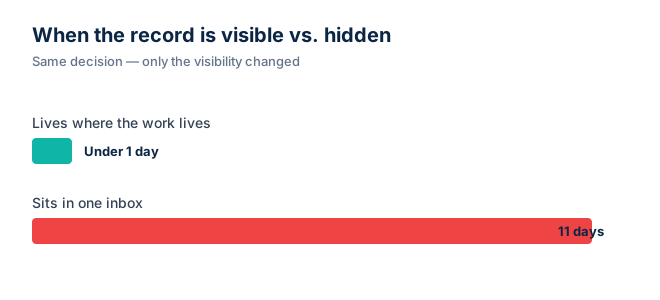
This matters because the cost of a lost record is rarely the record. It's the six weeks, the redone work, and the credibility you spend reconstructing something you already had.
Where the proof goes to hide
What a healthy record actually looks like
A healthy project record is not a folder full of PDFs. It is a small set of facts everyone agrees on: the approved scope, the current budget, the most recent change order, the latest payment certificate, and the person responsible for each. When those facts are written down in one place and updated as the project moves, almost every other problem gets easier.
The opposite is also true. When the same number lives in three spreadsheets and one email thread, people pick the version that suits the moment. That is how teams end up arguing about whether a contract was for the original amount or the revised amount, and why an auditor can finish a week of fieldwork without ever feeling sure.
Scope: written, signed, and dated, with every revision linked back to the original.
Budget: a single live figure, with every change explained in plain language.
Decisions: who approved what, when, and on what basis.
Payments: tied directly to the invoice, the PO, and the deliverable.
Most provincial agencies are managing multi-year capital plans across many sites across email, spreadsheets, and three or four tools that don't talk to each other. The information exists. It just can't be assembled when it counts.
The cost isn't only the missing document. It's the meeting to look for it, the second meeting to recreate it, and the slow erosion of trust every time someone has to say 'let me get back to you on that.'
There is a reason this keeps happening even to careful provincial agencies. The tools that hold the work — email, shared drives, spreadsheets, a project app or two — were each built to do one job well, not to keep a single, time-stamped record of what was decided and why. So the record becomes a manual chore bolted onto the real work, and it is the first thing to slip when multi-year capital plans across many sites gets busy. In a year shaped by Bill C-5 and the new Major Projects Office, that one dropped chore is exactly what returns, months later, as a finding, a dispute, or a number nobody can explain.
These are the records that go missing first:
How small problems become large ones
Every overrun and every audit finding starts as a small, ordinary mistake. A purchase order issued before the budget revision was approved. A change order signed by email and never logged. An invoice paid against the wrong cost code. Individually, none of these are dramatic. Together, over a multi-year project, they are how a clean file becomes a contested one.
Catch it at the door. The cheapest place to fix a records problem is the moment a document arrives, while the context is still fresh and the person who signed it is still reachable.
Tie every dollar to a decision. If a payment cannot be traced back to an approved scope item, it should not move. That single rule prevents most of the disputes that show up months later.
Keep the trail visible. A timeline that anyone on the team can scroll through, with the underlying documents one click away, is worth more than a polished report nobody trusts.
None of this requires heroics. It requires a system that quietly enforces the rules in the background so people can get on with the work.
The decision record — who approved what, when, and on what basis
Invoices matched to the contract that authorized them
The procurement justification, documented at the time
Version history proving which drawing was current on a given day
What Bill C-5 and the new Major Projects Office actually change
The short list of what should never be left scattered:
In practice: a week in the life
Picture a typical week on a mid-size capital project. A site instruction comes back from the contractor on Monday. A revised drawing lands on Tuesday. An invoice for last month's progress is submitted on Wednesday. A funder asks a quick question on Thursday. On Friday, someone has to put together a one-page status update for the board.
In a healthy system, each of those events updates the same shared record as it happens. The Friday status update is not a scramble; it is a printout. In a broken system, Friday is a panic, and the answer that goes to the board is whatever the loudest person in the room remembers. XNM-VISION is built to make the first version normal and the second version unnecessary.
Version history. Proof of which drawing, spec, or policy was current on any given day.
The contract and its change orders. The original plus every amendment, in order, with nothing living only in an email thread.
Procurement justification. Why this vendor, this price, this process — documented at the time, not rationalized after.
Closeout and retention. What was delivered, who signed for it, and proof you kept what you must keep.
Approvals and sign-offs. Every gate with a name and date attached, visible to everyone the decision touches.
You don't solve this with another reminder or another folder. You solve it by making the record a by-product of doing the work, not a second job.
The XNM-VISION records engine turns the scattered exhaust of a project into a single auditable record. For provincial agencies, that means a partner, funder, or auditor can be answered in minutes, not weeks.
Teams stand it up fast: the XNM-VISION records engine deploys in days, not the months a traditional system takes, and it carries unlimited users, so every partner, reviewer, and field lead works from the same picture.
Why this matters now
Capital is moving faster than it used to, and so is scrutiny. Funders want to see how their dollars were spent before they release the next tranche. Boards want a clear story they can repeat. Auditors want a trail they can follow without asking ten follow-up questions. Teams that can produce all three on demand keep their reputations, their funding, and their schedule. Teams that cannot, do not.
The good news is that the bar is lower than it looks. You do not need a perfect system. You need a defensible one: a single source of truth, kept current by the people closest to the work, with the ability to answer the obvious questions in minutes rather than days.
Funding gets you to the starting line. Records are what carry you across it. In a year defined by Bill C-5 and the new Major Projects Office, that distinction is the whole game.
This is the gap XNM closes for capital teams. Learn how in our overview of XNM-VISION.